Article|TSD-02A
When Concrete Has No Competition
Industrial slabs-on-ground may be the most innovative corner of the concrete flatwork industry. Its design guidance hasn't kept up.
Robert Rodden (The Slab Designer, LLC); Juan Pablo Covarrubias (TCPavements-FORTA)
The Slab Designer, LLC | Published October 21, 2026 | Revised November 4, 2026
There was a time when factory floors were made of wood blocks, brick, or cobblestone. You can still walk through old factories and see the remnants: end-grain timber worn smooth by carts, stone set by hand, surfaces that were never flat and never meant to be. Concrete changed that, but it didn't start indoors. It started on roads.
How concrete won the indoor market
Concrete pavement was built to solve a problem outside: wheels and hooves rutting soft streets. From there it moved inside, and once it did, it had the floor market almost to itself.
The reason has to do with how loads behave. On a road, most vehicles are moving fast, and fast loads are kind to pavement. It is at intersections, where trucks stop, sit, and turn, that the weaknesses of asphalt show up first, in ruts and shoves. Inside an industrial building, nearly every load behaves like an intersection. Rack legs sit in one spot for years. Lift trucks move slowly, turn sharply, and carry their weight on small wheels. Loads are far more concentrated than anything on a highway. Asphalt never made a good case for that market.
There is an interesting exception next door. At ports, asphalt and precast pavers still hold their own, even under the corner castings of stacked shipping containers, some of the most concentrated loads in any paved area. But once there are walls and a roof around the space, concrete is king.
No competition, no organized industry
That lack of competition has shaped the industrial floor market in a way most people never notice.
When concrete competes with asphalt, as it does on roads, streets, and airfields, the industry organizes around winning. Trade associations track square yards placed and market share, report them as key performance indicators, and fund research, guidance, and promotion to move those numbers. One of us (Robert) saw this firsthand during almost a decade at the American Concrete Pavement Association. Market share was the scoreboard.
Nobody keeps that scoreboard for industrial warehouse floors, because there is no one to beat. The Portland Cement Association, now the American Cement Association, once supported the market with its Concrete Floors on Ground manual. ACPA considered supporting industrial floors more than once over the years, but its members chose to keep the focus on streets, roads, and airfields. That left ACI Committees 302 and 360, on floor construction and slab-on-ground design, as the two places where the people who care about this niche consistently meet.
Without competition, there was little reason to organize. Engineers and contractors were left on their own to solve their problems. And they solved a lot of them.
A remarkable amount of innovation
The whole concrete industry is changing. Cements are changing so fast that the Portland Cement Association changed its name. There are innovative ideas in every corner of the business. But we would argue that no niche has innovated more, or faster, than industrial slabs-on-ground, and almost all of it came from private contractors and manufacturers working without an industry program behind them.
Consider how fast the loads changed. Lift trucks moved from air-filled tires to small, hard polyurethane wheels that put enormous pressure on a tiny contact area. Storage moved from standard pallet racks to very narrow aisles, automated storage and retrieval systems, and now data centers with their own demands. The floor went from a surface to stand on to the most important piece of equipment in the building, the thing that sets how fast and how high a facility can operate. That pace has outrun the ability of a committee that meets twice a year to refresh its guidance once a decade.
Engineers responded by building their own tools. In few other parts of the concrete industry have engineers developed their own finite element analyses and design methods simply because they needed answers the published guidance didn't give.
Contractors responded on the construction side:
- Large placements instead of strips. Floors used to be placed in long, narrow strips, much like a highway. Laser screeds made it more economical to place large blocks in a single pour, which cut the number of construction joints dramatically.
- Plate dowels. Bigger placements brought a new problem: round dowels restrained the joints, especially at the corners where joints meet in both directions. The industry answered with plate dowels, including tapered shapes, that carry load while letting the slab move. To many roadway engineers, that idea still seems foreign, which says a lot about how separate the two worlds are.
- Armored joints, and then better ones. As construction joints moved farther apart, they became the joints that open the most and take the most abuse. The industry first protected them with straight steel armor, then changed the geometry of the joint edge itself so that wheels cross gradually instead of dropping across a straight gap.
- Surfaces built for wear. Shake-on hardeners and shrinkage-compensating concrete are specified where surface abrasion matters, and abrasion resistance is increasingly measured with dedicated tests. Roadway engineers rarely think about abrasion at all.
- Materials that move fewer joints. Steel and macrosynthetic fibers, shrinkage-reducing admixtures, shrinkage-compensating concrete, and post-tensioning all let floors be built with far fewer joints than the old rules allowed.
The cost of innovating alone
When innovation comes entirely from the private market, it tends to arrive attached to a product or a patent. That has made ACI 360 in particular wary of new developments. Too often, an approach that has been proven in the field is set aside in committee as "proprietary," and the guide stays where it was. Within the committee, "we can't mention proprietary things" has become the default position without anyone asking whether it's true.
That's unfortunate, and it reads ACI's rules more broadly than they're written. ACI's Technical Committee Manual separates two things that tend to get lumped together: patented and proprietary.
The manual uses the word "proprietary" in only two places. One is the chapter on standards, meaning codes and specifications: a standard can't "endorse or promote patented products or proprietary technology of any kind," and can't name a product by trademark or trade name. Even there, a standard "may allow patented technology as a possible solution"; it just can't require it. The other is about convention presentations, which shouldn't promote proprietary products "without sufficient, objective, supporting data." Neither one is about guides.
What applies to every ACI document is about patents, and it's procedural. If a document refers to patented technology, the committee has to be told during balloting, and the document carries a standard patent disclaimer. Even a code commentary "may refer to patented items" that meet the intent of a provision. In other words, the manual expects patented technology to show up in ACI documents and tells committees how to handle it.
Proprietary isn't the same as patented, either. A lot of engineering software is proprietary only because the owner doesn't hand out the code. It holds no patents, and there's no patent question to ask. The manual's own test for presentations is a good one for guides too: is there sufficient, objective data behind it?
Some guides already describe proprietary tools. ACI Committee 330's guide for industrial and trucking facility paving, ACI 330.2R-17, has a section titled "Proprietary design software" that describes PavementDesigner.org, AASHTOWare Pavement ME Design, TCPavements OptiPave, and AIRPave by name. An industrial paving committee decided designers needed to know those tools exist. A consensus guide shouldn't endorse a brand, but it can describe what a proprietary approach does, alongside the other ways to get the same benefit. When someone brings a solution that saves money, time, or carbon, the answer should be to describe all the versions that provide it, not to leave them all out.
The market can't wait, either. ACI 360R-10 recommends plate dowels at 18 inches (460 mm) on center. By 2017, the largest plate dowel manufacturer reported that only 44% of the baskets it sold over three years were at 18 inches (460 mm); the majority were spaced wider, reflecting research and market changes since the guide's fixed 18-inch recommendation. The industry moved past the guide's number years ago. But the result is a guide that still leans on design theory from the 1920s, Westergaard's solutions for a slab in full contact with the ground, alongside yield-line approaches like TR34 that make similar assumptions, while the industry around it has moved on.
Nothing proprietary about physics
We would put this to readers, and to the committees: the many slab systems the industry has developed are not a collection of competing products. They are different positions in the same design space.
Every slab-on-ground design balances variables like these: how stiff the support is, how much friction there is between the slab and the base, how much the concrete shrinks and curls, how much it moves with temperature, how far apart the joints are, how well the joints pass load, how tough the concrete is and how much the slab can carry, and how realistically the loads are described. That isn't a complete list, and it doesn't need to be. It only needs enough levers to tell one slab system from the next. Each system pulls on them differently (Figure 1).
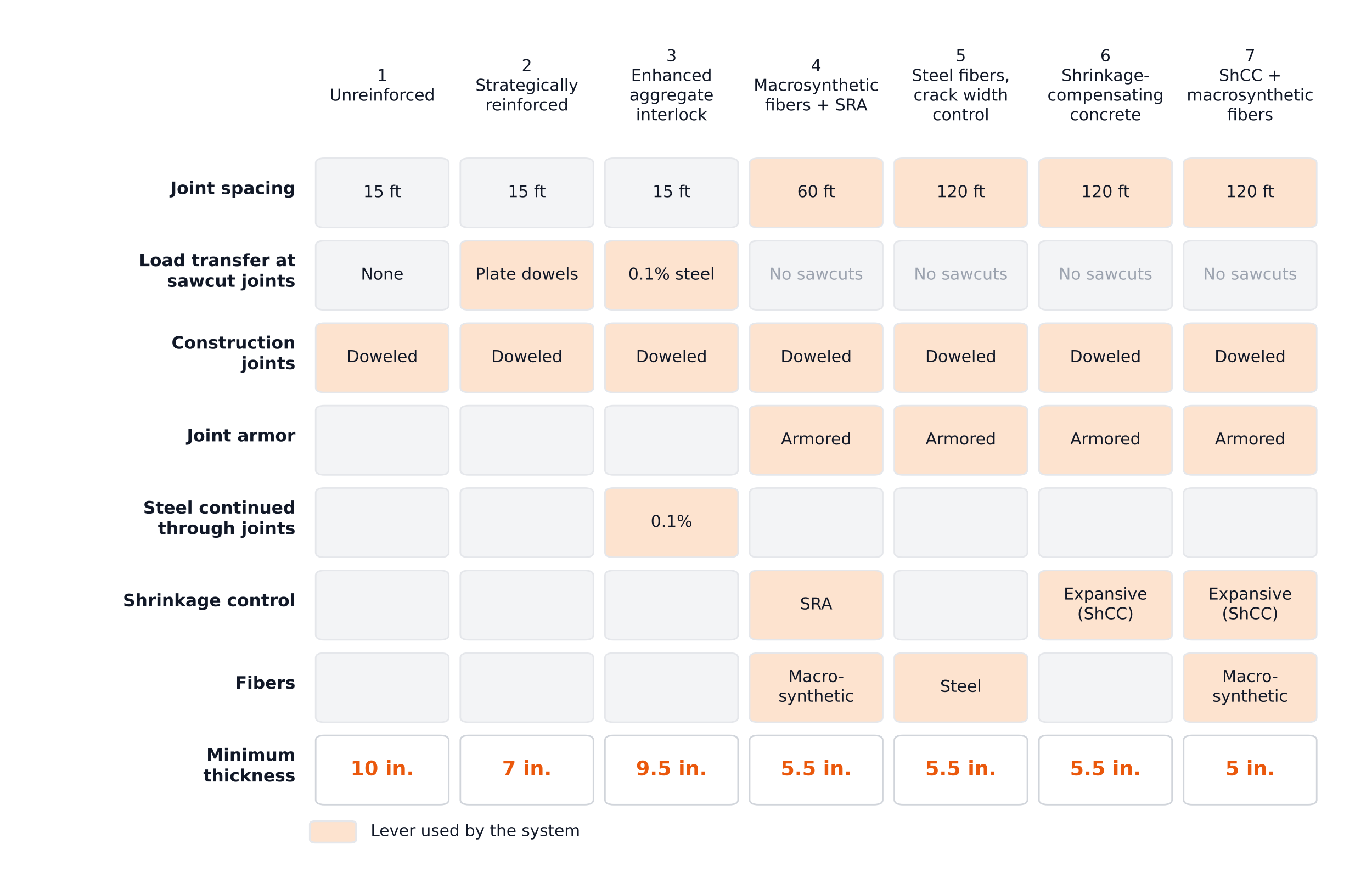
In the comparison we published with Nigel Parkes in ForConstructionPros in July, the same warehouse, at the same location with the same loads, needed a 10-inch (250 mm) slab with joints about every 15 feet (4.6 m) when it was built with the least engineering: no load transfer, no shrinkage control, and no enhancements to the concrete. Built with shrinkage-compensating concrete and macrosynthetic fibers, it needed 5 inches (130 mm) with joints every 120 feet (37 m). Nothing about the second design is proprietary. It simply pulls harder on the shrinkage and joint-spacing levers, and the physics responds.
Seen that way, a future version of ACI 360 could be organized around the fundamentals of slab-on-ground engineering: support, friction, curl, materials, joints, load transfer, and loading. The different slab systems, whether they came from innovation, trial and error, or drag-from-the-past methods like Westergaard and TR34, would then fit into one logical framework. The discussion would shift from "is this proprietary?" to "how does this choice change the slab, and by how much?" That is a question engineering can answer.
Competition, but from the inside
Industrial floors have had plenty of competition. It's just all been inside the concrete industry: system against system, method against method, debated in committees that meet twice a year and update their guides about once a decade. ACI 360R-92 came from a committee of 11. The 2006 and 2010 editions came from committees of 29. Today there are 33 members, and it has been 16 years since the last edition. That isn't a knock on the people involved. George Garber, in Design and Construction of Concrete Floors, explains that standards are conservative by nature, because "it normally takes years for a standard-writing committee to adopt a new idea," and that they can't replace the designer's own judgment.
That pace made sense when the loads, the buildings, and the tools changed slowly. They don't anymore. Automated warehouses go from drawing board to operation in a year or two. Design tools that once took weeks of analysis now run in seconds. In the age of AI, the floor industry can't afford to wait ten years to learn what it already knows.
The innovators in this market have carried it a long way on their own. The next step is guidance that organizes what they've learned into a framework a designer can use, so the best ideas in the industry stop looking proprietary and start looking like engineering.
Sources
ACI Committee 360, ACI 360R-10, Guide to Design of Slabs-on-Ground, American Concrete Institute, 2010.
Covarrubias, J. P., Parkes, N., and Rodden, R., "Concrete Slab-On-Ground Thickness Requirements From Modern Design," ForConstructionPros, July 2026.
Farny, J. A., and Tarr, S. M., Concrete Floors on Ground, EB075, fourth edition, Portland Cement Association, 2008.
Garber, G., Design and Construction of Concrete Floors, 2nd ed., Butterworth-Heinemann, 2006.
ACI Committee on Technical Committee Procedures, ACI Technical Committee Manual, American Concrete Institute, revised July 2026.
ACI Committee 330, ACI 330.2R-17, Design and Construction of Concrete Site Paving for Industrial and Trucking Facilities, American Concrete Institute, 2017.
PNA Construction Technologies, "Standardized Basket Design Reduces Project Costs," August 2017.
Related in This Series
- Technical paper on this topic: Industrial Slab Systems as Positions in One Design Space
Proposes organizing slab guidance around physical design levers so new systems are evaluated as engineering, not products.
- Corduroy Roads to Pavement ME: What a Century of Concrete Roads Can Teach Floors
How each pavement problem produced a fix, how floors borrowed the theory, and where floors now lag the roads.
- Thickness Ain't Nothin' but a Number
Why the thickest slab is often the least engineered one, and what the roads learned when they measured it.
- The Design Guide a New Engineer Can't Design From
A new engineer follows ACI 360R-10 step by step and finds the places it raises an issue and stops.
- The Floor Design Guide That Calls Its Own Results Erroneous
What owners should know about the trap built into the industry's main slab design guide.
Revision history
- November 4, 2026: Corrected the description of ACI's rules on proprietary items; redrew Figure 1 to show doweled and armored joints in every system; folded the standards discussion into the section on pace; clarified that ACI's restriction on proprietary items is written for codes and specifications; named TCPavements OptiPave; broadened the list of design levers; rewrote the ACI Technical Committee Manual discussion from its full text: patented versus proprietary, and what applies to standards versus guides.
- October 28, 2026: Added the ACI 330.2R-17 proprietary design software example; added metric units.
- October 21, 2026: First published on slabs.design/knowledge.
To cite this article, use the citation printed in the PDF. It includes the revision date, so readers can match your citation to the text you read.