Article|TSD-03A
Thickness Ain't Nothin' but a Number
A thicker slab is not automatically a better slab. Decades of pavement performance data, and a fresh look at floors, show why.
Robert Rodden (The Slab Designer, LLC); Juan Pablo Covarrubias (TCPavements-FORTA)
The Slab Designer, LLC | Published October 22, 2026 | Revised November 4, 2026
A while back, after a few messages saying ACI 360R-10 was being quoted "without full context," one of us (Robert) let the text speak for itself and ran a word count on the whole guide.
"Joint" is the 4th most common word in the Guide to Design of Slabs-on-Ground, behind only slab, concrete, and load. It shows up 487 times. "Shrinkage" is 7th, at 268. "Thickness" is 10th, at 174. Curl shows up 121 times. Joints get almost three times the attention thickness does, and shrinkage gets one and a half times as much.
That's not an accident. The people who wrote the guide knew that slab performance is about the whole system. Yet ask most owners what they know about their warehouse floor, and you'll get one number: the thickness. It is the one dimension on the drawings everyone understands, it is easy to check with a core, and it feels like a direct measure of strength. Six inches sounds light. Ten inches sounds serious.
That instinct is understandable, and it's wrong often enough to cost owners money and performance. Thickness matters, but it is one variable among many, and it is not even the one that best predicts how a floor will perform. In some respects, adding thickness makes things worse.
Same building, five inches apart
In July, we published a comparison with Nigel Parkes in ForConstructionPros of seven ways to build the same warehouse floor: same building and location, same rack and lift truck loads, with the concrete changing along with the slab system. The required thickness ranged from 10 inches (250 mm) down to 5 inches (Figure 1).
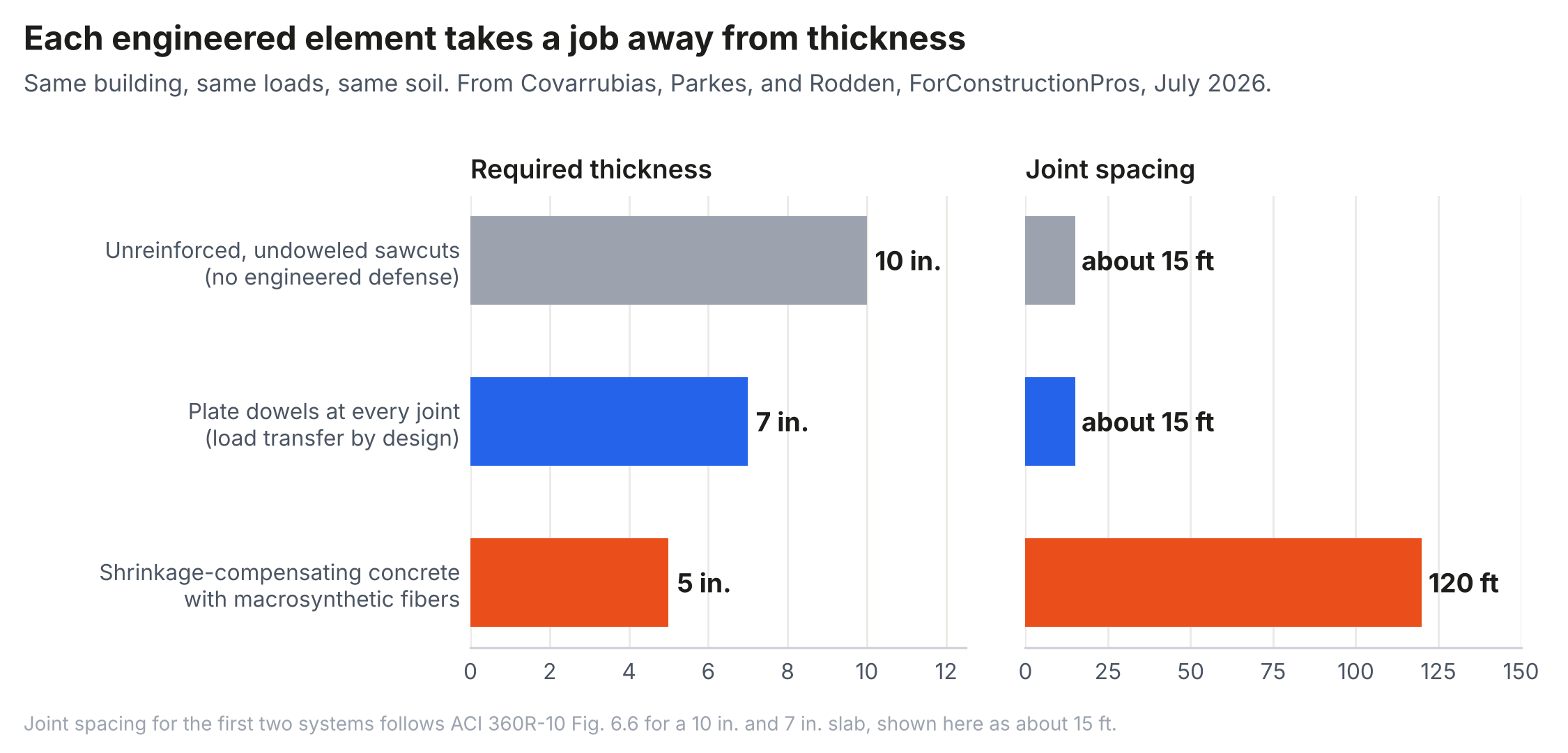
The thickest slab, at 10 inches (250 mm), was the plain one: unreinforced, with ordinary sawcut joints and nothing to pass load from one panel to the next. Its joints were expected to open about an eighth of an inch, at which point they pass almost no load. It used a typical concrete mix with no special attention to shrinkage or curl. In other words, it had no engineered defense against anything. Every wheel crossing a joint and every rack post next to one had to be carried by the edge of a single panel, and the only tool left to handle that was more concrete.
That is the important point. The 10-inch (250 mm) slab was not the "strongest" option. It was the one with the lowest bar of engineering, and it was rightly the thickest, because thickness was doing every job by itself.
Add one engineered element, plate dowels at every joint designed for 90% load transfer efficiency, and the same floor needed 7 inches (180 mm). Load transfer efficiency compares how much the unloaded side of a joint deflects to how much the loaded side deflects. At 90%, the two sides move almost together, and the next panel picks up a little under half the load (about 45%) while the loaded panel carries the rest. Even a perfect joint only splits a load 50/50. That sharing, and keeping both sides of the joint moving together under a wheel, is what protects joint edges from spalling over time. Thickness no longer had to do that job alone.
Then change the materials. With shrinkage-compensating concrete and macrosynthetic fibers, the same floor needed only 5 inches (130 mm), and its joints moved from about every 15 feet (4.6 m) to every 120 feet (37 m). Across the systems in our comparison that used fibers, shrinkage reducers, or shrinkage-compensating concrete, the floors had 78% to 91% fewer joints than a traditionally jointed slab. Joints are the weak points of a floor, the places where curl, spalling, and maintenance concentrate. Fewer of them is a performance gain on its own, separate from the thinner section.
That is why the industry has been moving in this direction for decades. Engineered elements and better materials do not just save concrete. They change what the slab has to resist and where.
Thicker can mean more curling stress
Here is the part that surprises people. Every indoor slab curls, because the top dries and shrinks more than the bottom, and the edges lift. When a slab curls, its own weight tries to pull the lifted edges back down, and that tug-of-war is what creates curling stress. A thicker slab is heavier and stiffer, so for the same drying conditions, it fights back harder.
Run the numbers with the formulas and design values in ACI 360R-10, the industry's main slab design guide, and the result is clear (Figure 2). At the guide's own recommended joint spacing and its design gradients for indoor slabs, the curling stress in a 10-inch (250 mm) slab is roughly double what it is in a 5-inch (130 mm) slab, on the order of 500 to 600 psi (3.4 to 4.1 MPa) compared with about 300 psi (2.1 MPa). Thicker slabs also get longer joint spacing in the guide's chart, which pushes their curling stress up further.
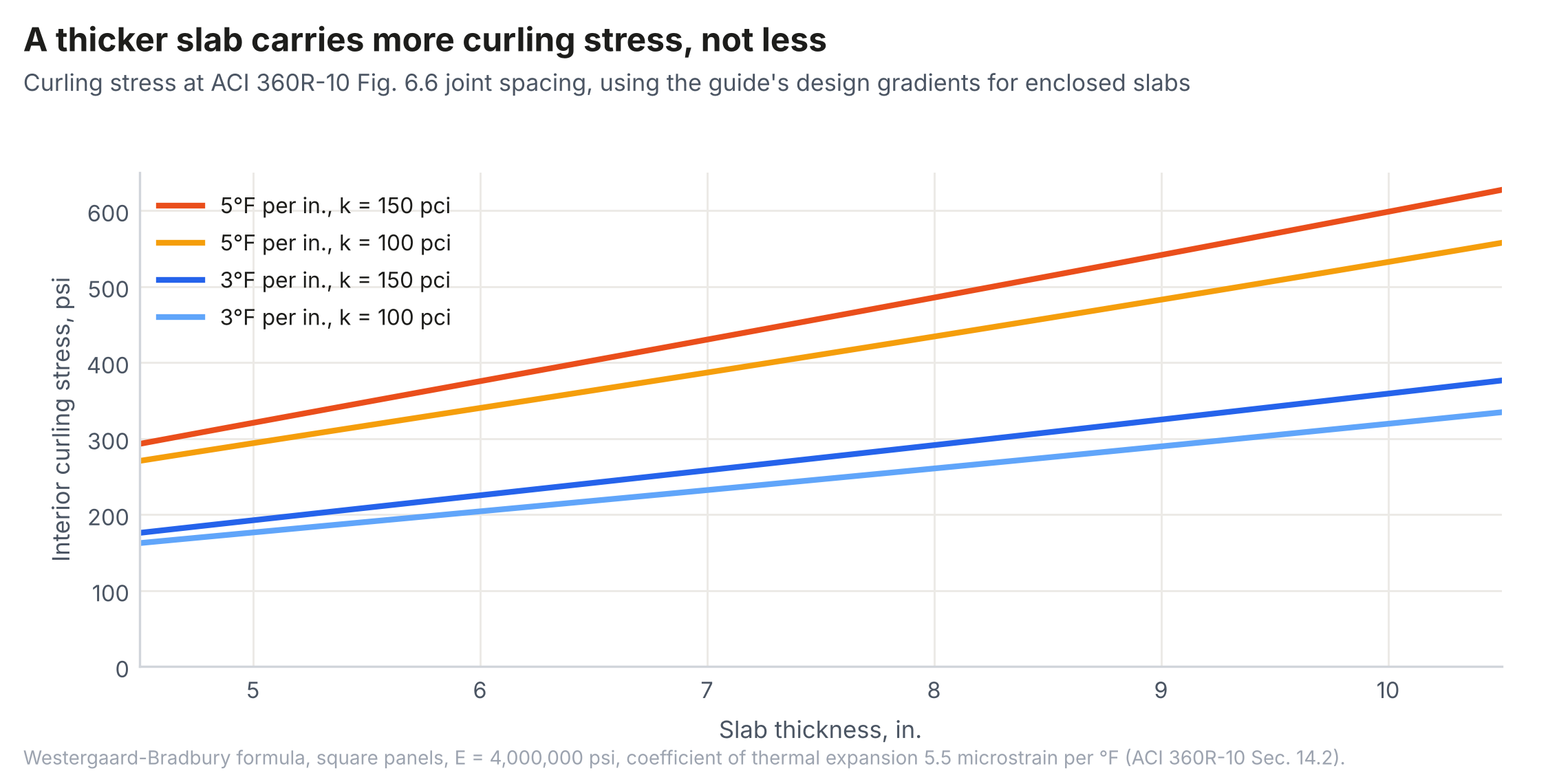
Real drying is concentrated near the top of a slab, so in practice the difference may be smaller than this simple calculation suggests. But the direction does not change: adding thickness does not buy down curling stress. If curl is what cracks your floor, more concrete is not the fix. Lower shrinkage, a better curing approach, shorter joint spacing, or a system that offsets shrinkage altogether is.
Two more inches didn't fix the joints either
Here's one from the 1960s. PCA ran a famous set of lab tests on aggregate interlock, repeatedly rolling heavy loads across joints in 7-inch (180 mm) and 9-inch (230 mm) slabs. ACI 360R-10 still quotes them. Replotted in today's terms (load transfer efficiency against joint opening), the data hold a surprise. With repeated loads, both slabs dropped below 90% load transfer at a joint opening of just 0.015 inch (0.38 mm). The 9-inch (230 mm) slab was no better than the 7-inch (180 mm) slab. An extra 2 inches (50 mm) of concrete didn't fix a joint that opened.
And if the ground under a floor settles unevenly, a thicker slab actually opens its joints and cracks wider at the surface for the same differential settlement. Thicker isn't automatically tougher.
The dolly pad dilemma
Picture a trailer parked at a dock with its dolly legs down, and the concrete under those little pads crushed and broken. Is that a thickness failure? Or is it a surface problem: strength, toughness, and impact resistance right at the top of the slab? Most of the time, adding an inch to the whole floor is an expensive way to address a problem that lives in the top inch.
What the roads taught us
None of this is new to pavement engineers. The concrete highway industry spent decades learning it the hard way, and then paid to measure it.
The Long-Term Pavement Performance program, known as LTPP, tracked thousands of pavement sections across North America for decades. That data became the basis for the national mechanistic-empirical design method, first called the MEPDG and now AASHTOWare Pavement ME. Unlike older methods that picked a thickness from charts, it predicts how a pavement will actually crack, fault, and roughen over its life, based on its structure, materials, climate, and traffic.
When researchers working under the National Cooperative Highway Research Program, including a team from Iowa State University, ran a large normalized sensitivity study of that method, they ranked which inputs most affect predicted performance of jointed concrete pavements. Thickness was on the list, at number two. But the top ten also included concrete strength and stiffness, joint spacing, edge support, and four inputs that control how much the slab curls and how much stress that curl creates: how much sunlight the surface absorbs, how fast heat moves through the concrete, how much the concrete expands and contracts with temperature, and how much the concrete weighs. Thickness is one key, but it shares the ring with curl and the rest.
In a 2014 comparison of U.S. pavement design methods that one of us (Robert) co-authored with Gerald Voigt and Leif Wathne at ACPA, the newer method showed something the older chart-based methods could not: if the support under the slab was too stiff, the required thickness went up, not down, because a stiffer base increases curling stress. A method that only looks at thickness, load, and support would never predict that. One that is calibrated to how real pavements performed does. What that means for choosing a k-value is covered in Stop Asking the Slab to Fix the Soil. The same study showed how much dowels reduce the required thickness, the highway version of the 10-inch (250 mm)-to-7-inch (180 mm) result above.
The lesson the roads learned is that thickness is one variable in a system, and the old logic that more of it is always better did not survive contact with performance data.
The good news about thickness
The thicknesses the industry has used for years aren't the problem. They're close to what a doweled slab needs. PCA's own 2008 lift truck example comes out at 180 mm (7 in.) with doweled joints, 205 mm (8 in.) with aggregate interlock, and 235 mm (9.25 in.) at a free edge, with the same truck, concrete, and soil every time. Our spec building comparison came out at 7 inches (180 mm) doweled and 10 inches (250 mm) undoweled. So where an interior-load design framework was used to justify the thickness, a floor with dowels at every joint has a factor of safety much closer to what the engineer of record intended than one without dowels, or one counting on aggregate interlock or light steel. That second floor is quietly eating into its factor of safety. Nobody has to make floors thicker to fix that. The joints have to carry their share.
What to ask instead of "how thick?"
If you own, build, or specify floors, thickness is still worth knowing. It just shouldn't be the first question or the last. Better ones:
- How do the joints pass load from one panel to the next, and what load transfer was assumed in the design?
- How was curling handled, and what shrinkage and drying conditions were assumed?
- How many joints are there, and could a different system or material reduce them?
- What does each extra inch of thickness actually buy that an engineered element or a better mix could not do more cheaply?
If a concept is discussed that much in a design guide, it should show up in the design method too. Thickness interacts with joints. Thickness interacts with shrinkage. Thickness interacts with curl. A thick slab with no load transfer, ordinary concrete, and closely spaced joints is not the conservative choice. It is the least engineered one, carrying every job with mass alone. Thickness ain't nothin' but a number. The system is what performs.
Sources
ACI Committee 360, ACI 360R-10, Guide to Design of Slabs-on-Ground, American Concrete Institute, 2010.
Covarrubias, J. P., Parkes, N., and Rodden, R., "Concrete Slab-On-Ground Thickness Requirements From Modern Design," ForConstructionPros, July 2026.
Rodden, R., Voigt, G., and Wathne, L., "Comparison of Roadway Jointed Plain Concrete Pavement (JPCP) Thickness Design Methods Common in the United States," 12th International Symposium on Concrete Roads, Prague, Czech Republic, 2014.
Colley, B. E., and Humphrey, H. A., "Aggregate Interlock at Joints in Concrete Pavements," Highway Research Record 189, 1967.
Schwartz, C. W., Li, R., Kim, S. H., Ceylan, H., and Gopalakrishnan, K., "Sensitivity Evaluation of MEPDG Performance Prediction," NCHRP Project 1-47, National Cooperative Highway Research Program, 2011.
Related in This Series
- Technical paper on this topic: Slab Thickness as an Outcome, Not an Input
Shows how load transfer, curl, support stiffness, and surface demands, not thickness alone, govern slab performance.
- When Concrete Has No Competition
Industrial floors innovated without an industry program behind them. The guidance hasn't kept up.
- The Design Guide a New Engineer Can't Design From
A new engineer follows ACI 360R-10 step by step and finds the places it raises an issue and stops.
- Corduroy Roads to Pavement ME: What a Century of Concrete Roads Can Teach Floors
How each pavement problem produced a fix, how floors borrowed the theory, and where floors now lag the roads.
- The Floor Design Guide That Calls Its Own Results Erroneous
What owners should know about the trap built into the industry's main slab design guide.
Revision history
- November 4, 2026: Attributed the word count to Robert.
- October 29, 2026: Completed references; added metric units and links to other pieces in the series.
- October 26, 2026: Added the point that typical thicknesses work as intended when joints are doweled.
- October 22, 2026: First published on slabs.design/knowledge.
To cite this article, use the citation printed in the PDF. It includes the revision date, so readers can match your citation to the text you read.